Floor Jack vs. Ramps vs. Jack Stands: How to Lift Your Car Safely
Which lifting setup fits your car, your driveway and the jobs you plan to do, plus the safety rules that are not optional.
Reviewed by Michael Koster · Updated October 2026
The one rule
A hydraulic jack lifts. It does not hold. Any time part of you is under the car, the weight is on jack stands or ramps, never on the jack alone.
Work on a flat, hard surface. Asphalt in summer and gravel at any time are not hard surfaces; a jack stand will sink into both.
Chock the wheels that stay on the ground, set the parking brake, and shake the car before you go under it.

Ramps: the oil-change special
Drive up, chock the rear, done. There is nothing to bleed down and no lift point to find, which makes ramps the easiest option for a beginner.
Limits: only the front (or rear) goes up, so no tire rotations. Low cars may not clear the approach angle without an extender, and the car has to be driven on carefully; a wheel rolling off a ramp is the classic ramp accident.
Check the gross vehicle weight rating, not the per-ramp number. Most plastic ramps are rated for 12,000 lb GVW, which covers everything short of a one-ton truck.


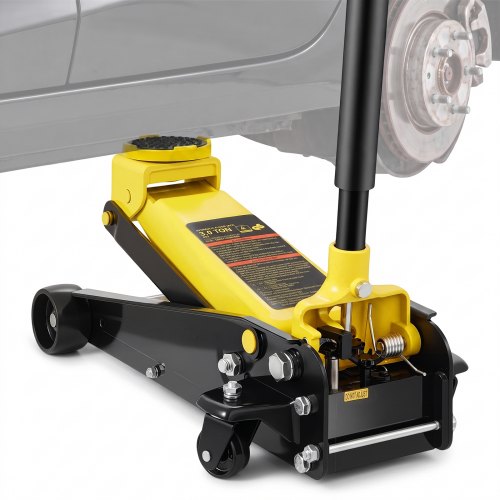
Floor jack plus stands: the do-everything setup
Lift at the factory jack point, slide a stand under the frame rail or pinch-weld support, lower onto the stand, repeat on the other side. Now the wheels are free and you can rotate tires, do brakes or change a wheel bearing.
Buy the jack for the lowest car you own and the stands for the heaviest. A 2-ton low-profile jack and 3-ton stands cover nearly every passenger vehicle. Trucks want a 3-ton jack and 6-ton stands.
Look for double-locking stands (ratchet plus a pin). Ratchet-only stands were the subject of a large recall in 2020.



What about the scissor jack in the trunk?
It is designed to change one tire at the side of the road, once. It is slow, it tips easily and it has no business under a car you are working on.
Where to put the jack and the stands
Your owner’s manual shows the jack points. On unibody cars that is usually the reinforced pinch weld behind the front wheel and ahead of the rear wheel; a rubber slotted pad on the jack saddle keeps the weld from folding.
Trucks and body-on-frame SUVs lift on the frame rail or the differential housing (rear) and the frame or lower control arm (front), per the manual.
Stands go on a frame member, never on the floor pan, a suspension arm that can move, or the plastic underbody panels.
Our recommendation
If you will only ever change oil: ramps and chocks. If you want to rotate tires or do brakes: a low-profile floor jack, double-locking stands and chocks. Many people end up with both, using ramps for oil and the jack for everything else.
Vevor’s steel jacks and ramps are hard to beat on price. For jack stands specifically, buy a pair with a published rating and a pin lock, whichever retailer sells them.
- The DIY Oil Change Tool Kit: What You Actually Need
- Do You Need a Torque Wrench for an Oil Change?
- Oil Extractor vs. Drain Plug: Is Topside Oil Extraction Any Good?